Rochester Hills Homes for Remote Workers That Fit Daily Life
June 25, 2026
June 25, 2026
If you work from home even part of the week, you know a pretty house is not always a practical one. The wrong layout can make calls harder, concentration thinner, and your workday feel longer than it needs to. In Rochester Hills, you can be more selective about finding a home that supports both your job and your everyday life. Here’s what to look for, what questions to ask, and why this area stands out for remote professionals. Let’s dive in.
Rochester Hills offers a strong mix of connectivity, comfort, and day-to-day convenience for remote and hybrid buyers. The city’s 2025 population estimate is 77,539, and the local housing profile points to a stable, owner-occupied market built for longer-term living.
Just as important for work-from-home households, 95.6% of households have a broadband subscription and 96.9% have a computer. That level of connectivity supports the idea that Rochester Hills is not just a place to sleep between commutes. It is a place where you can realistically build a productive home routine.
The city also has a median household income of $120,694 and a bachelor’s-degree-or-higher rate of 61.4%. Combined with a 76.7% owner-occupied housing rate, those numbers suggest a market where buyers often prioritize function, privacy, and flexibility over short-term fixes.
For hybrid professionals, the area also offers practical access. The median travel time to work is 24.3 minutes, which can matter if you split your time between home and the office.
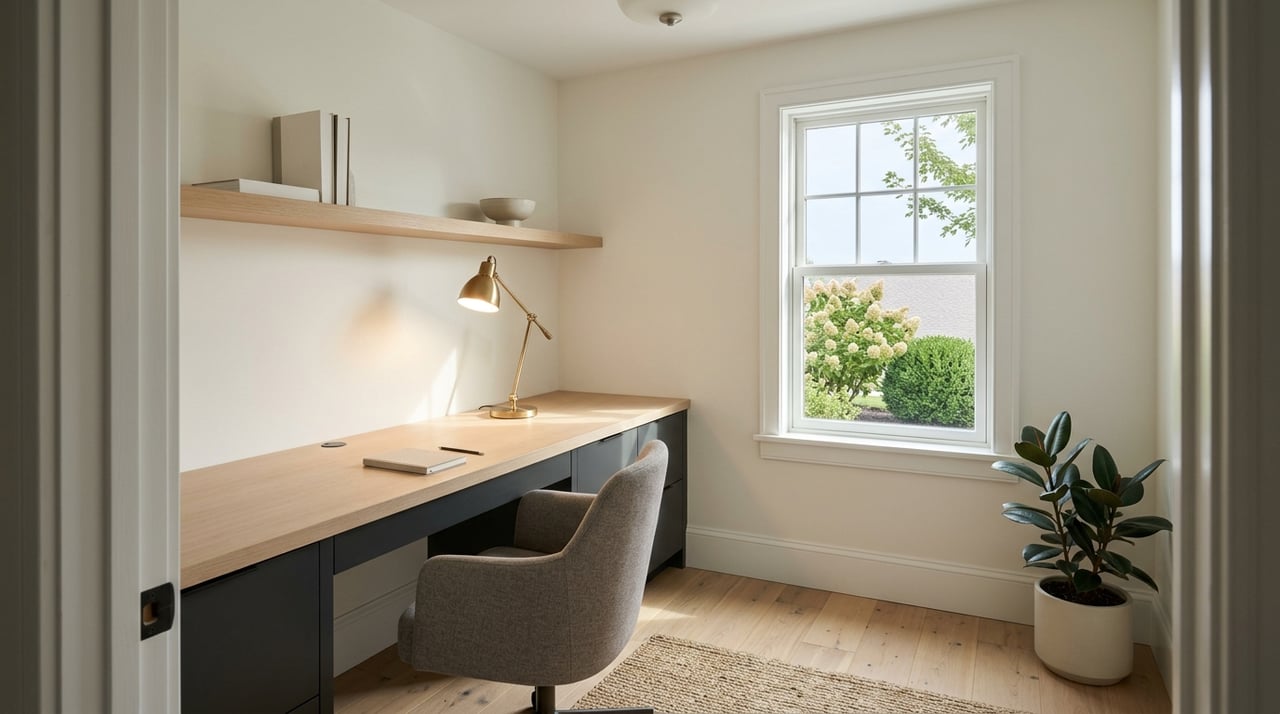
When you start touring homes, the best remote-work features are usually the most practical ones. You are not just looking for a stylish corner with a laptop. You are looking for a space that can support real work for six to eight hours a day.
A dedicated office is ideal, but many homes offer useful alternatives. In listings, watch for rooms labeled office, den, study, library, loft, bonus room, or flex room.
What matters most is how the space functions within the full layout. A beautiful desk setup near the kitchen may photograph well, but it may not work during meetings, focused tasks, or a full workday.
A strong layout helps separate your work life from your home life. If the workspace sits away from the kitchen, living room, and primary bedroom, you may get better focus and fewer interruptions.
This is especially relevant in Rochester Hills, where there are 29,486 households and the average household size is 2.54 people. If more than one person is home during the day, separation can make a big difference.
A workable office needs more than a spare chair and good intentions. You want enough wall depth and outlet access for a desk, monitor, and printer, plus a setup that feels comfortable over time.
Natural light also matters. Windows and daylight can make computer work easier and improve how you appear on video calls, but you still want enough control over glare and room placement.
Closable doors are another major plus. If you take meetings, handle confidential calls, or simply need quiet, a room with a door often outperforms an open nook every time.
In many homes, the best office is not the one the listing highlights first. A finished basement, upstairs loft, or first-floor bonus room can often create a better work zone than a formal living space.
These overflow areas can also help future-proof your purchase. If your job changes, your household grows, or you need a second workspace later, flexible square footage gives you more options.
Listing photos can be helpful, but they should never be the only test. Staging can make a room look office-ready even when it lacks privacy, storage, or usable dimensions.
A better approach is to ask whether the space could function as a real work zone every day. If the listing description is vague, focus on the floor plan and room dimensions instead of the decorative setup.
Here are a few useful listing signals to watch for:
If you are considering a condo or townhome, expand your checklist a bit. Guest parking and a practical package-delivery setup can matter more than buyers first expect, especially if you host occasional visitors or receive work shipments.
A remote-friendly home is only part of the equation. Your daily routine also works better when nearby amenities make it easy to step away, reset, or run errands without disrupting your schedule.
The Village of Rochester Hills is a 375,000-square-foot outdoor shopping district in the heart of the city. Its directory includes Starbucks, Whole Foods Market, Barnes & Noble, plus a wide mix of shopping and service uses.
For remote professionals, this kind of nearby convenience can make the workweek smoother. You can grab coffee, pick up groceries, handle errands, or meet someone for lunch without leaving Rochester Hills.
The center is open seven days a week, offers free parking, and provides directions from both I-75 and M-59. That easy access adds convenience for both daily life and part-time commuting.
Some days, you simply need a change of scenery. Rochester Hills Public Library can be a practical backup workspace for residents.
The library offers study rooms, meeting rooms, public computers, printers, one-on-one technology help, and checkout of laptops and Wi-Fi hotspots. Residents of Rochester, Rochester Hills, and Oakland Township with valid library cards have priority access to public computers.
Library hours are Monday through Thursday from 9 a.m. to 9 p.m., Friday and Saturday from 9 a.m. to 6 p.m., and Sunday from 1 p.m. to 6 p.m. For buyers who value flexibility, that kind of resource adds real day-to-day support.
Working from home can blur the line between productivity and burnout. Access to parks and green space can help you build small breaks into your day.
Rochester Hills provides a broad set of parks and natural-resource sites, including Innovation Hills, Bloomer Park, Thelma G. Spencer Park, Veterans Memorial Pointe, and Avon Nature Study Area. The city also provides park maps, trail markers, and a parks tour map.
That means you have realistic options for a quick walk between calls or a midday reset when you need one. For many remote professionals, that kind of nearby outdoor access improves long-term livability just as much as the office itself.
Before you schedule a showing, it helps to think like someone who will actually work in the home, not just sleep there. Small details can have a major impact on your daily routine.
Ask these questions as you narrow your options:
These questions can help you move past surface appeal and focus on daily function. That is often where the best long-term decisions are made.
Rochester Hills has a housing profile that makes flexible square footage especially relevant. The median gross rent is $1,644, and median monthly owner costs with a mortgage are $2,208.
When you are making a move at these price points, it makes sense to buy with your routine in mind. An extra room, a quiet loft, or a finished basement can support your current job needs while also giving you options for guests, hobbies, storage, or future life changes.
That practical mindset fits the market well. In a city with high broadband adoption, strong computer ownership, and a largely owner-occupied housing stock, buyers can afford to be thoughtful about what “home office ready” really means.
The best Rochester Hills home for a remote professional is not always the flashiest one. It is the one that reduces friction during the workday, supports your schedule, and still feels good when the laptop closes.
That might mean a dedicated office with a door, a flexible upstairs loft, or a finished lower level with room to spread out. It might also mean staying close to everyday conveniences like the library, parks, and the Village of Rochester Hills.
If you want help sorting through Rochester Hills homes with a practical, lifestyle-first lens, Madelon P. Ward can help you evaluate layout, neighborhood fit, and the details that matter for how you actually live and work.
We pride ourselves in providing personalized solutions that bring our clients closer to their dream properties and enhance their long-term wealth. Contact us today to find out how we can be of assistance to you!